
Postponed – New Date Coming Soon

The Science, Technology and Medicine Seminar (STMS) series, co-hosted by the Medical Ethics and Humanities Unit and the Department of History at the University of Hong Kong, promotes cutting edge cross-disciplinary research that straddles the arts, sciences, and medicine. The aim is to provide a friendly forum to debate and test new ideas, papers, chapters, book projects and grant proposals, as well as topical issues and individual research.
If you are interested in joining, or participating in future seminars, please let us know. We welcome suggestions for future presentations and discussion topics.
For further information about STMS activities,
please contact Dr Ria Sinha at riasinha@hku.hk, or Dr Carol Tsang at cctsang1@hku.hk.
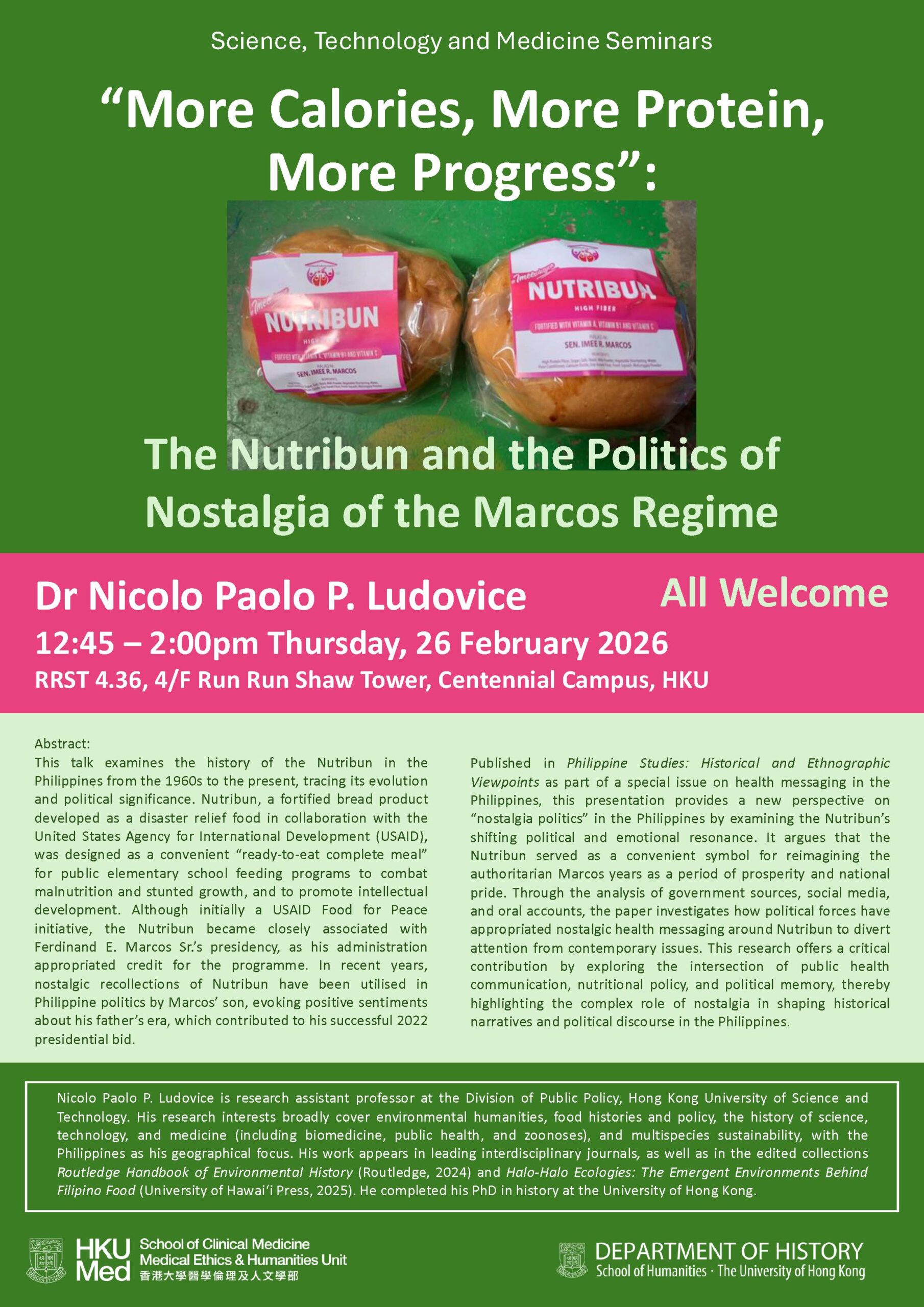
Upcoming seminar:
26 Feb 2026 (Thursday) | 12:45-2:00 pm | RRST 4.36 (Faculty Conference Room 4/F Run Run Shaw Tower, Centennial Campus, HKU)
Title: “More Calories, More Protein, More Progress”: The Nutribun and the politics of nostalgia of the Marcos Regime
Speaker:
Dr Nicolo Paolo P. Ludovice (Research Assistant Professor, Division of Public Policy, HKUST)
Abstract:
This talk examines the history of the Nutribun in the Philippines from the 1960s to the present, tracing its evolution and political significance. Nutribun, a fortified bread product developed as a disaster relief food in collaboration with the United States Agency for International Development (USAID), was designed as a convenient “ready-to-eat complete meal” for public elementary school feeding programs to combat malnutrition and stunted growth, and to promote intellectual development. Although initially a USAID Food for Peace initiative, the Nutribun became closely associated with Ferdinand E. Marcos Sr.’s presidency, as his administration appropriated credit for the programme. In recent years, nostalgic recollections of Nutribun have been utilised in Philippine politics by Marcos’ son, evoking positive sentiments about his father’s era, which contributed to his successful 2022 presidential bid.
Published in Philippine Studies: Historical and Ethnographic Viewpoints as part of a special issue on health messaging in the Philippines, this talk provides a new perspective on “nostalgia politics” in the Philippines by examining the Nutribun’s shifting political and emotional resonance. It argues that the Nutribun served as a convenient symbol for reimagining the authoritarian Marcos years as a period of prosperity and national pride. Through the analysis of government sources, social media, and oral accounts, the paper investigates how political forces have appropriated nostalgic health messaging around Nutribun to divert attention from contemporary issues. This research offers a critical contribution by exploring the intersection of public health communication, nutritional policy, and political memory, thereby highlighting the complex role of nostalgia in shaping historical narratives and political discourse in the Philippines. By exposing the constructed nature of nostalgia, this study calls for more critical perspectives on the uses of health messaging and nutritional history in politics
Bios:
Nicolo Paolo P. Ludovice is research assistant professor at the Division of Public Policy, Hong Kong University of Science and Technology. His research interests broadly cover environmental humanities, food histories and policy, the history of science, technology, and medicine (including biomedicine, public health, and zoonoses), and multispecies sustainability, with the Philippines as his geographical focus. His work appears in leading interdisciplinary journals, as well as in the edited collections Routledge Handbook of Environmental History (Routledge, 2024) and Halo-Halo Ecologies: The Emergent Environments Behind Filipino Food (University of Hawai‘i Press, 2025). He completed his PhD in history at the University of Hong Kong.